
What if the version of you that’s been struggling — the one carrying all that weight, all those old stories — simply doesn’t exist anymore?
Not in a fluffy, feel-good way. In a real, fundamental way.
Here’s an idea that sounds wild at first, but once it lands, it genuinely changes how you move through the world. Bear with me — because this isn’t another “think positive and everything will be fine” piece. This is something that cuts deeper than that.
You Are Not the Same Person You Were a Moment Ago
In every single moment, you are a completely new version of yourself. Not metaphorically. Not as a motivational soundbite. Actually, genuinely new.
Your reality shifts from moment to moment. And here’s the kicker — any change is a complete change. There is no half-updated version of you. Every moment is a clean slate.
You’ve probably heard people say “you can reinvent yourself.” But this goes deeper than reinvention. Reinvention suggests you’re modifying something that already exists. What we’re really talking about is the understanding that the “old you” isn’t even there anymore. You’ve already moved on. The question is whether you’re choosing to drag the past into the present with you.
Think about that for a second. The person who got knocked back last year, the one who made that mistake, the one who felt stuck — biologically, neurologically, experientially — you are not that person anymore. Cells have changed. Thoughts have shifted. Circumstances have moved. The only thing keeping that version alive is your insistence on referencing it.
You are not a fixed object moving through time. You are a continuous unfolding, moment by moment. And every moment offers a genuinely new starting point — if you’re willing to take it.
The Story You Keep Telling
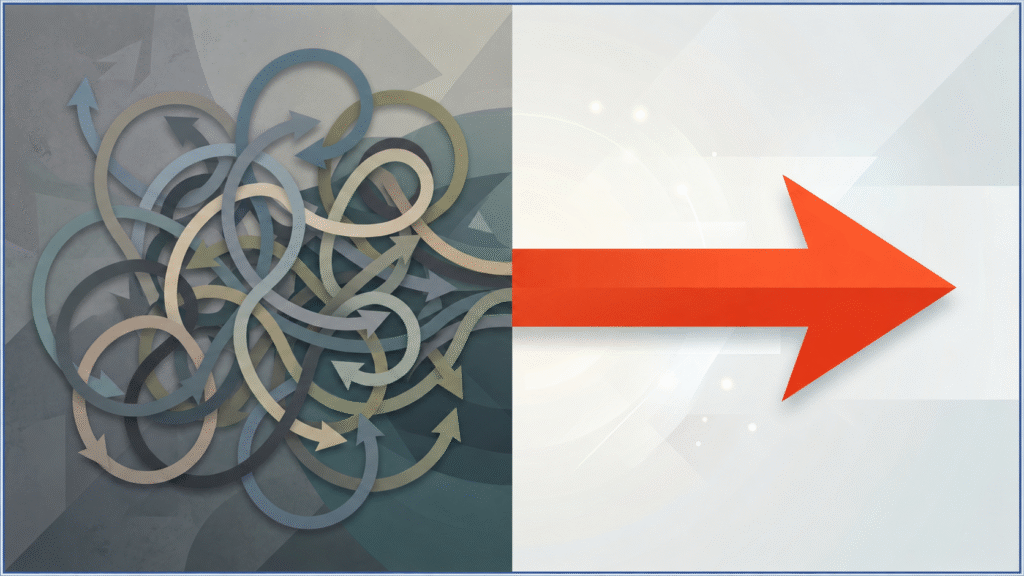
So if you’re new in every moment, why does life feel so stuck?
One word. Story.
The continuity you experience between yesterday and today — the sense that you are the same person, living the same life, with the same problems — that isn’t a fixed, objective reality. It’s a story you’re actively telling yourself, right now, in real time.
Think of your life as a sequence of frames, like a film reel. Each frame is a completely separate moment. But your mind threads them together into a narrative. And that narrative becomes your experience.
The problem? Most of us are threading those frames together with the same story on repeat. “I’ve always struggled with money.” “Good things never happen to me.” “I’ve been through too much to expect things to change.”
Those aren’t facts. They’re a story. And here’s what nobody tells you — your brain isn’t neutral. It isn’t passively recording life as it happens. It is actively filtering billions of pieces of sensory information every second and only surfacing the data that confirms what you already believe. That’s not a personality flaw. That’s how human perception works.
Which means if your story is one of struggle, limitation, and disappointment, your mind will literally screen out evidence to the contrary. You won’t notice the opportunity. You’ll dismiss the compliment. You’ll find a reason the good thing won’t last. Not because you’re broken, but because your brain is doing exactly what you’ve trained it to do — confirming your story.
The good news? You trained it. Which means you can retrain it.
There Is No Objective Reality Out There
This is where it gets interesting — and a bit uncomfortable if you’re attached to the idea that life is something that happens to you.
What you experience as “reality” — your circumstances, the way people treat you, the opportunities that show up or don’t — is not some fixed, objective world sitting out there independent of you. It’s a subjective experience, shaped entirely by your beliefs, your assumptions, and the story you’re running.
Two people can live through the same event and walk away with completely different realities. One finds a lesson. One finds a wound. Same event. Different story. Different life trajectory from that point forward.
That’s not philosophy. That’s lived human experience.
Most of us are walking around waiting for our circumstances to change before we change our story. But it works the other way round. The story comes first. The circumstances follow. You don’t get the confidence and then take the leap. You take the leap from a new story, and the confidence builds in the doing.
If you’ve been treated poorly, you may have built an identity around that. And when you build an identity around something — even something painful — you start filtering your entire world through it. You stop noticing the moments that contradict it. You keep finding confirmation of the very thing you don’t want to be true. That’s not bad luck. That’s your story working exactly as designed.
Suffering Is a Decision
Here’s the bit that stings a little. But it’s also the most freeing thing in this entire piece, so don’t skim past it.
Suffering is a decision.
Not the painful experiences themselves — those are real, and nothing here is about dismissing them or pretending they didn’t happen. You’ve been through things. Some of them were genuinely hard. This isn’t toxic positivity asking you to pretend otherwise.
But the meaning you attach to those experiences? That’s a choice. And that meaning is what determines whether an experience defines you or simply passes through you.
You are the one giving meaning to what happens in your life. You decide what it means that things didn’t work out. You decide what it means that you were let down, passed over, or held back. You decide whether that makes you someone life happens against, or someone life is happening for — even when it doesn’t feel that way.
And the meaning you assign creates the next frame of your reality.
This isn’t about blame. It’s the opposite. Blame keeps you powerless — a victim of forces outside yourself. What we’re talking about is ownership. The recognition that you are the source of your experience, which means you hold the power to write the next chapter differently.
End of “Suffering Is a Decision”. The Big Leap by Gay Hendricks goes deeper into exactly this — why we unconsciously sabotage our own progress and how to stop. Worth every page.
Why Most People Stay Stuck Even When They’re Doing the Work
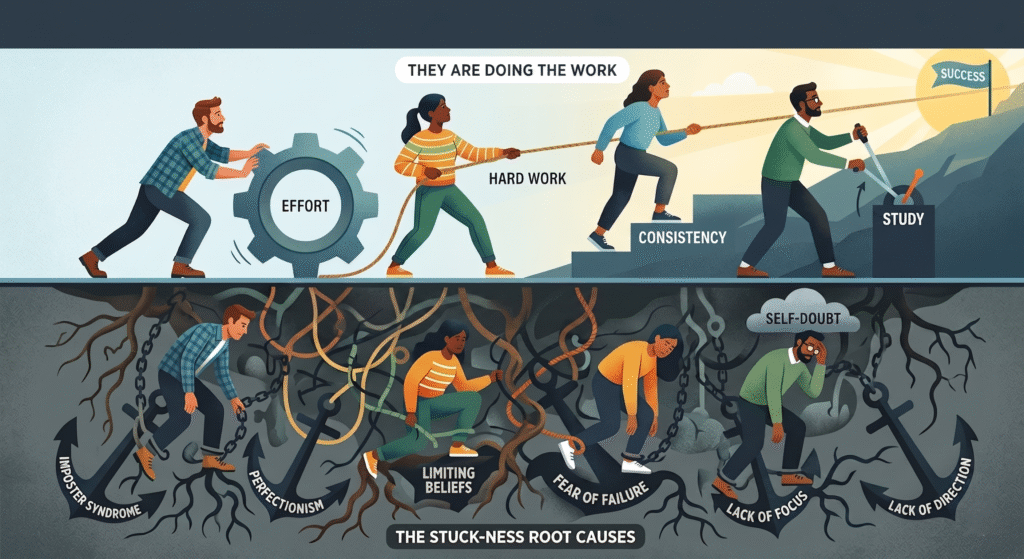
Here’s something worth addressing, because a lot of driven people hit this wall and think something is fundamentally wrong with them.
You’ve done the journaling. You’ve set the intentions. You’ve read the books, listened to the podcasts, maybe worked with a coach. You have the inner knowing. You genuinely believe something better is possible. And yet — nothing seems to change.
The issue usually isn’t effort. It’s that the new story hasn’t fully replaced the old one yet.
You’re doing the visualisation in the morning and then spending the rest of the day reacting to life through the lens of the old story. You’re affirming abundance while anxiously checking your bank balance and feeling that familiar knot in your stomach. You’re imagining the dream life and then narrating everything that’s wrong with your current one.
The new story has to become your dominant operating system — not just something you visit during a morning routine. That means catching yourself mid-narrative. It means noticing when you’re threading the old frames together and making a conscious choice to thread different ones. Not suppressing the old story, but simply choosing not to give it the wheel.
That’s precisely what How to Win the Time Management War — The Tactical Playbook tackles head on. Not more productivity hacks — a structured framework for people who are ready to stop spinning and start executing.
So What Do You Actually Do?
You make a decision.
Not a vision board. Not a vague intention. A clear, committed decision to adopt a new story — and to hold that story even when your current circumstances are pushing back hard against it.
In this moment, you are not the person who failed. You are not the person who was let down. You are not your history. Those were different frames. You are here, now, at zero point — a completely new version of you, with a completely new story available to you, right now.
The past is not out there waiting to drag you back. You are recreating it right now by choosing to include it in your current narrative. And you can choose not to.
That doesn’t mean pretending it didn’t happen. It means deciding it no longer gets to write the next chapter. You get to determine what those experiences mean going forward — and you get to determine that from a new version of yourself, one that isn’t bound by what the old version went through.
Change your story, and you change what you see. Change what you see, and you change what’s possible. Change what’s possible, and your decisions change. Your decisions change, and your life changes. It really does flow from there.
All possible versions of your life exist right now. The one where things work out. The one where you’re the person you’ve always wanted to be. The one where the so-called dream life isn’t a distant fantasy but simply the story you chose to live from.
That version of you isn’t far away. It isn’t locked behind years of therapy or a perfect set of circumstances. It’s available in the next moment — the moment you decide to tell a different story.
And that moment? It’s right now.
If you want a practical daily anchor for the new story you’re building, The 6-Minute Diary is worth keeping on your desk. Six minutes a day, rooted in positive psychology — small habit, real shift.