
More hours won’t fix it.
If they were going to, they already would have. You’ve had the late nights. The early starts. The weekends that quietly became part of the working week.
And still — that feeling of being genuinely on top of things stays just out of reach.
The problem isn’t how long you’re working. It’s something else entirely.
It’s Not a Time Problem. It’s a Clarity Problem.
Feeling out of control rarely comes from having too much to do.
It comes from not knowing clearly enough what matters most. When everything feels equally urgent, you end up triaging all day — putting out fires, responding to whatever’s loudest, never quite getting to the work that would actually move things forward.
More hours in that state doesn’t help. It just means more triage.
Clarity is the lever. When you know what your real priorities are — and why they matter — the noise settles. Not because the demands disappear, but because you have a filter. Most of what feels urgent stops qualifying.
Stop Measuring the Day by How Much You Did
There’s a version of a productive day that looks like a cleared inbox, a long ticked list, and back-to-back activity from 8am to 6pm.
That version is a trap.
Real progress rarely looks like volume. Some of your most valuable work sessions will produce one thing — one piece of writing, one decision made clearly, one conversation that unblocks everything else. Not twenty tasks. One thing done properly.
Give yourself permission to measure the day by what actually moved forward, not how busy it looked. That shift alone takes a surprising amount of pressure off — and usually improves the quality of your output at the same time. learn more in the How to Win The Time Management War – Tactical Playbook
Work With Your Energy, Not Against It
You already know you have better hours and worse hours. Most people just ignore that information.
They schedule their hardest, most important work for whenever a gap appears in the calendar — not when their brain is actually equipped to handle it. Then they wonder why it takes twice as long as it should, or why the quality isn’t there.
Try this instead. For one week, pay attention to when focus comes easily and when it fights you. Then move your most important work into that peak window — and push the emails, admin, and low-stakes tasks into the natural dips.
You’re not working longer. You’re working in alignment with how you actually function. The difference in output can be significant — and it costs nothing except a little intentional rearranging.
Shrink the List
Most to-do lists are optimistic fiction.
Fifteen items. Twenty items. A rolling backlog that never clears and quietly generates a constant hum of incompleteness in the background — even on days when you’ve actually done a lot.
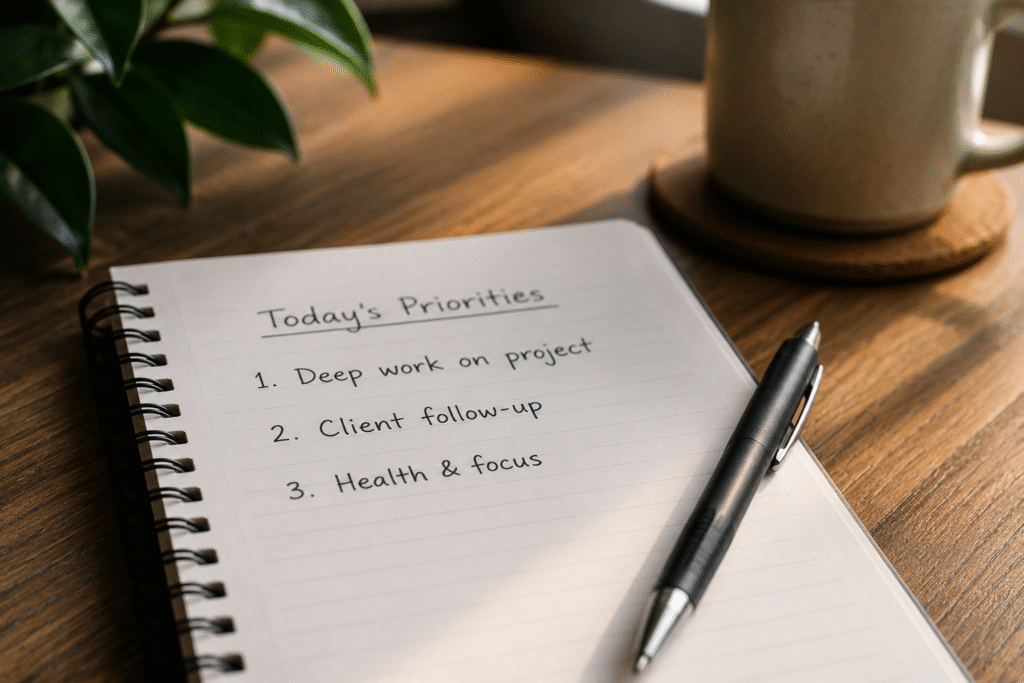
Try capping your daily list at three to five items. Choose them deliberately the night before. Make them specific enough that you’ll know unambiguously when they’re done.
A short list you finish beats a long list that defeats you every single time. The momentum of actually closing the loop — of ending the day having done what you said you’d do — builds something that no productivity app can replicate. The How to Win The Time Management War – Tactical Playbook is built around this kind of practical, no-fluff approach to getting the right things done consistently.
Put Edges Around Your Day

One of the fastest ways to feel more in control is to create clear boundaries around when you work and what you work on.
A defined start. A defined finish. Blocks of time assigned to specific types of work — and defended consistently enough that your brain learns when it’s time to focus and when it’s time to switch off.
Without those edges, the day bleeds. Work creeps into evenings. Evenings creep into sleep. The mental load never fully lifts because there’s no clear signal that it’s safe to put it down.
You don’t need a rigid military schedule. You just need enough structure that focused work and genuine rest both have a real place in your day — not just whatever’s left over after everything else.
Control Is Built, Not Found
Here’s what nobody tells you: feeling in control of your day isn’t a circumstance you stumble into when the workload finally drops.
It’s something you build — through small, consistent decisions about where your attention goes, and the conviction that those decisions are the right ones.
Clarity over busyness. Impact over volume. Energy over hours.
That’s the version of control that actually holds up. And it’s available right now, with exactly the hours you already have.
If you’re ready to build a proper structure around it — one that works for your life, not someone else’s template — The How to Win The Time Management War – Tactical Playbook lays out the practical framework to make it happen.