
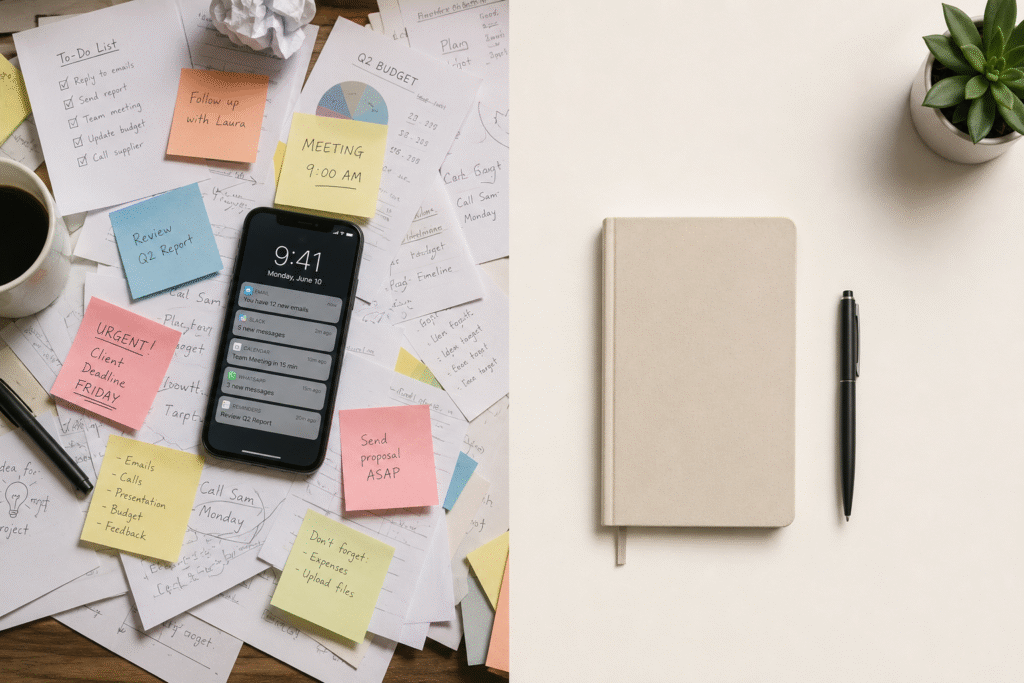
Most chaotic days don’t start chaotic.
They start with good intentions. A rough idea of what needs doing. A sense that today’s going to be different.
Then an email lands. Someone needs something. A quick task turns into forty minutes. And by early afternoon you’re reacting to everything and driving nothing — wondering, again, where the day went.
Sound familiar?
The fix isn’t a better app or a more detailed schedule. It’s one shift. And most people never make it.
Decide Before the Day Decides for You
The single most effective thing you can do to take back control of your day is to design it before it begins.
Not an elaborate planning ritual. Just five to ten minutes — the evening before works best — to answer one question clearly:
What are the three things that, if done today, would make today a success?
Not a full task list. Not everything that’s on your plate. Three things.
When you start the day knowing the answer to that question, everything else can be evaluated against it.
Does this move one of my three things forward? If not, it waits. That single filter changes how you respond to the day rather than just absorbing it.
Most people skip this step because it feels too simple to make a real difference. It isn’t. It’s the difference between a day you direct and a day that happens to you.
Why Reactive Mode Feels Productive — But Isn’t
Reactive mode has a convincing disguise. Your inbox is busy. Messages are coming in. You’re responding fast, moving quickly. It feels like momentum.
But here’s what’s actually happening: someone else’s priorities are running your day. You’re solving their problems, attending to their needs, and keeping their wheels turning — while your most important work sits untouched.
That low-level anxiety you carry into the evening? It’s usually not about how much you did. It’s about what didn’t move forward.
The shift from reactive to intentional isn’t about ignoring the world. It’s about deciding — before the world shows up — what gets your best attention first.
That one decision, made consistently, is worth more than any productivity app you’ll ever download.
If you want a clear, structured approach to making that shift stick — How to Win the Time Management War — The Tactical Playbook is built around exactly this. Practical, actionable, and designed for people who are done with vague advice.
The Evening Habit That Changes Everything
Five minutes before you close your laptop tonight, do three things.
Review what you actually completed today. Write your three priorities for tomorrow. Then mentally close the day — give yourself permission to put it down.
That’s it.
It sounds almost too simple. But this one habit stops unfinished tasks from haunting your evenings and disrupting your sleep. It means you start tomorrow already knowing what matters — rather than figuring it out under pressure while the notifications stack up.
It also does something less obvious. It trains your brain to treat the working day as a defined thing with a beginning and an end — rather than a permanent background hum that never fully switches off. Over time that boundary becomes one of the most protective things you can build around your focus and your wellbeing.
Most people skip this because it doesn’t feel like real productivity. It absolutely is.
Cut the Micro-Decisions
A chaotic day is often just a day full of small, unnecessary decisions.
What should I work on first? Should I check email now? Is this worth responding to? What about that thing I said I’d do this week?
Each of those micro-decisions burns a little mental fuel. By mid-morning you’re already running low — and the important work still hasn’t started. This is decision fatigue in action, and it quietly derails more people than almost any other productivity killer.
The fix is to make those decisions in advance, in bulk, when your thinking is clear.
Plan the next day before the current one ends. Set a rule for when you check email — and stick to it.
Batch similar tasks into dedicated windows so you’re not constantly switching between different types of thinking. Create a short daily template that handles the routine stuff without deliberation.
You’re not adding rigidity. You’re removing friction. And the mental energy you free up goes straight back into the work that actually matters.
Your Morning Sets the Tone — Protect It
How you spend the first hour of your working day has a disproportionate impact on everything that follows.
Most people spend it reacting. Inbox first. Messages first. Other people’s agendas first. By the time they get to their own priorities the morning is already gone and the day has taken on a shape they didn’t choose.
High performers do it differently. They protect the first hour. No inbox. No messages. Just the most important task on the list — started and ideally finished before the rest of the world fully shows up.
It doesn’t require getting up at 5am or overhauling your entire morning. It just requires deciding, the night before, what that first task is — and committing to it before you open anything else. How to Win the Time Management War — The Tactical Playbook walks through how to structure this kind of intentional morning in a way that’s realistic and sustainable, not just aspirational.
When Things Go Off Track — And They Will
No plan survives contact with the day entirely intact. Things come up. Priorities shift. Unexpected demands land.
The goal isn’t a perfectly executed schedule. It’s having an anchor strong enough to return to when the day pulls you off course.
That anchor — your three priorities, your plan, your defined end point — is what separates people who finish the day with a genuine sense of progress from people who finish exhausted but unsure what they actually achieved.
When something disrupts your day, the question isn’t “how do I get back on track with everything?” It’s simply: “which of my three things still needs to happen today?” That clarity cuts through the noise fast.
Build the Habit, Not Just the System
Here’s the thing about all of this — it only works if you do it consistently.
A daily planning habit practiced for two weeks will do more for your productivity than the most sophisticated time management system used sporadically. Consistency is the multiplier. Without it, even the best approach produces patchy results.
Start small. Commit to the five-minute evening review for one week. Just that. Write tomorrow’s three priorities before you close your laptop. Do it every day without exception.
By the end of the week you’ll feel the difference — not dramatically, but noticeably.
A little more clarity at the start of each day. A little less anxiety at the end of it. A slightly stronger sense that you’re directing your time rather than just spending it.
That feeling, built on consistently, is what genuine control actually feels like. And it starts with one small decision made the night before. How to Win the Time Management War — The Tactical Playbook gives you the full structure to take it further — but the first move is always the simplest one.
Decide before the day decides for you.