You know the conversation. You have been having it with yourself in the shower, during your commute, and at two in the morning when the house is quiet.
It usually starts with a quiet admission: This isn’t working. Maybe it is a job that has shrunk your ambition down to a paycheck. Maybe it is a relationship running on fumes, a business model that stopped making sense two quarters ago, or a personal habit you keep promising to address once things settle down.
And right behind that admission comes the familiar second half of the thought: I just don’t know what the next step looks like yet.
So you wait. You gather a little more information. You tell yourself you are being prudent, strategic, and patient. You wait for the fog to clear, for a sign, or for the timing to feel less precarious.
Here is the question nobody likes to ask while they are busy being prudent: what has waiting already cost you?
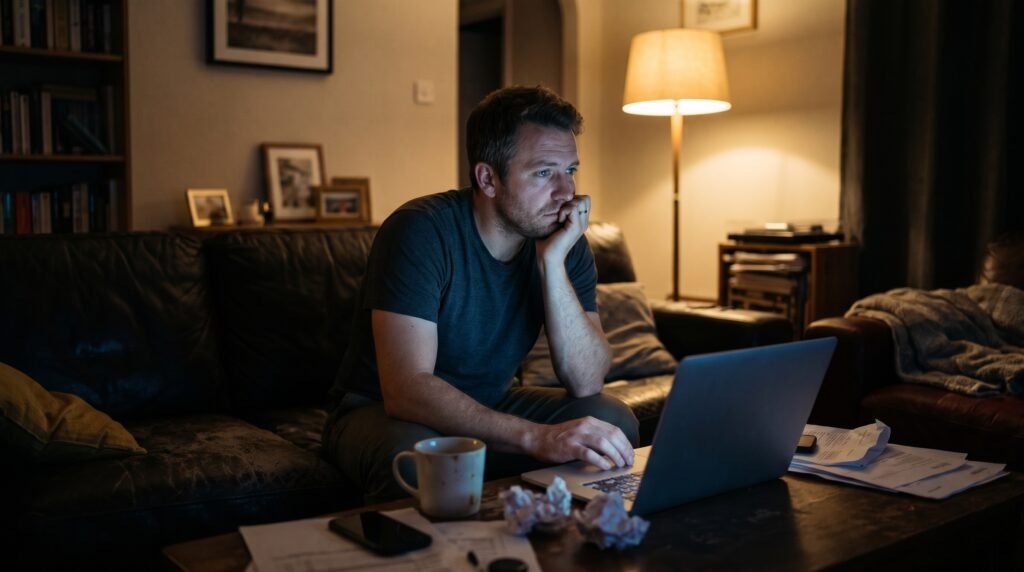
Most of us evaluate risk in only one direction. We calculate everything that could go wrong if we move. We run through the worst-case scenarios of making the jump, having the hard conversation, or launching the untested idea. Almost never do we run the numbers on what happens if we stay put. We treat inaction as a neutral baseline—a safe pause button where nothing gets better, sure, but nothing gets worse either.
In reality, standing still is rarely neutral. It is a decision with a compounding price tag. Every month you spend circling a decision you already know you need to make drains energy, erodes self-trust, and narrows your options. You aren’t preserving your safety; you are just paying for your comfort in slow installments.
Four Men at the Gate
There is a remarkably blunt story in the Old Testament that cuts right through the illusion of safe inaction. It shows up in 2 Kings 7:3–8, during one of the darkest stretches in Israel’s history.
The Aramean army had surrounded the city of Samaria, cutting off all supply lines. Nothing was getting in, and nothing was getting out. Inside the walls, the siege had dragged on so long that famine had driven people to unthinkable desperation. Money was worthless because there was nothing left to buy.
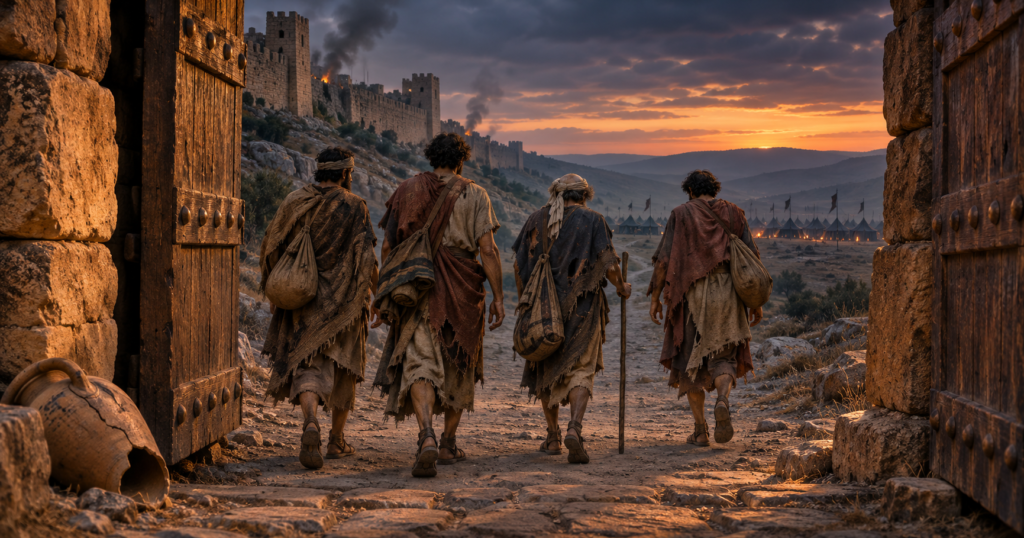
Outside the city gate sat four men with leprosy. Because of their disease, Jewish law required them to live apart from the rest of the community. They couldn’t go inside the city, and even if they could, there was no food waiting for them there anyway. They were stuck in the margins of a dying town, watching the clock run out.
Eventually, they looked at one another and asked a question that stripped away every excuse: “Why stay here until we die?”
They laid out their options in plain terms. If they went into the city, the famine would kill them. If they stayed right where they were at the gate, they would die there too. Their only remaining option was to walk across the valley to the Aramean camp and surrender. If the enemy soldiers spared them, they would live. If the soldiers killed them, well—they were already dead men walking.
At dusk, they got up and started walking toward the enemy lines.
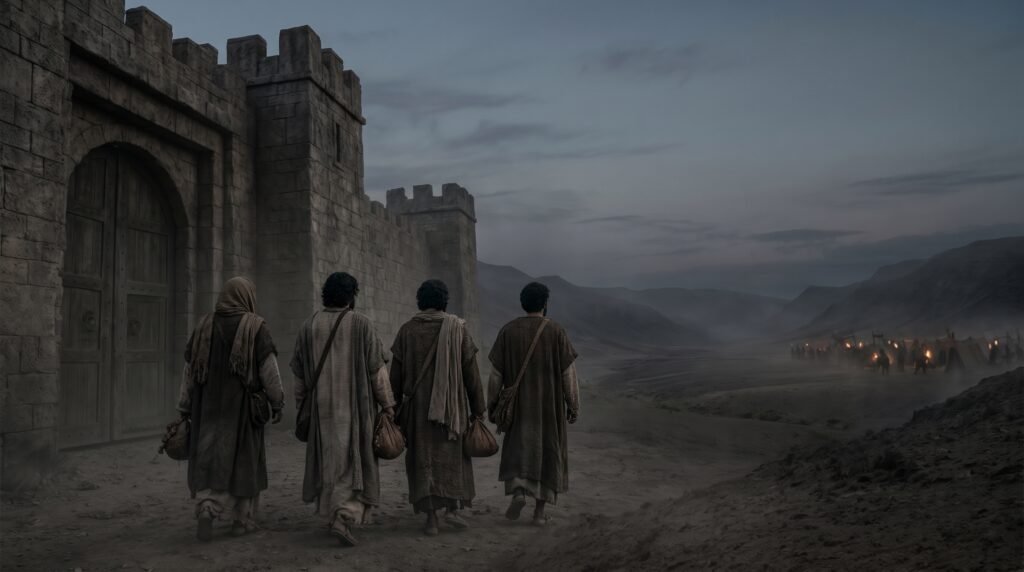
What they didn’t know was that God had already intervened on the other side of the valley. As the four men approached, God caused the Aramean army to hear the deafening sound of chariots, horses, and a massive approaching force. Convinced that Israel had hired neighboring kings to ambush them, the soldiers panicked. They abandoned their tents, their horses, their silver, their gold, and their food, running for their lives into the night.
When the four men walked into the edge of the camp, expecting spears and chains, they found silence. They stepped into a tent, ate and drank their fill, carried off silver and clothes to hide, and then—realizing the sheer scale of what they had stumbled into—went back to tell the starving city the siege was over.
The Lie of the Safe Default
It is tempting to read a story like that and turn it into a neat little formula: Take a leap of faith, and God will empty the enemy camp for you.
That is not how real life works, and it isn’t even what the four men believed. They didn’t walk toward the Aramean camp because they had a guarantee of success. They didn’t receive a vision of empty tents before they took their first step. In fact, they walked forward fully aware that the worst-case scenario—getting killed by enemy soldiers—was entirely on the table.
They moved because they finally stopped pretending that staying at the gate was safe.
When you are standing in the middle of an uncertain season, faith isn’t pretending you know how things will turn out. Faith is trusting that God is already at work beyond what you can see, and recognizing that obedience rarely happens while you are standing still. You cannot steer a parked car, and you cannot discover what God has prepared down the road while you are camped out at the gate.
More importantly, those four men were honest about the math. They looked at their current location and realized that staying put had a 100% failure rate. Moving forward at least introduced the possibility of life.
We miss that math all the time. Because our current situation isn’t an ancient military siege, the slow decay feels manageable. It doesn’t feel like dying; it just feels like being tired, stuck, or slightly resentful. So we stay at the gate, convincing ourselves that uncertainty is worse than stagnation. On the website The Waking Lion, we often explore how breaking through this kind of internal hesitation requires awakening the dormant resolve within us.
What Staying at the Gate Looks Like Today
You don’t need to be starving outside a walled city to fall into this trap. It plays out in quiet, ordinary ways every single week.
The Delayed Launch
Consider a business owner who has spent eight months building a new service or product. On paper, it solves a real problem. Early feedback from a few trusted peers has been solid. Yet every time the launch date approaches, the owner finds a new reason to push it back. The website copy needs another pass. The onboarding workflow feels clunky. Maybe they should wait until the next quarter when budgets open up.
What makes this decision hard isn’t laziness; it is exposure. As long as the product stays in development, it remains full of potential. The moment it goes live, real customers get to judge it. It might flop. Nobody might buy it.
So the owner stays at the gate. Meanwhile, staying there quietly bleeds cash, burns out the team, and gives competitors six extra months to claim the exact same space.
A sensible first step here isn’t betting the entire company on a massive marketing campaign. It is setting a non-negotiable launch date two weeks out, stripping the offer down to its simplest working version, and putting it in front of ten real prospects to see if anyone will actually pay for it. You don’t need certainty to test an idea; you just need a pulse.
The Avoided Conversation
Or think about something closer to home: a relationship—whether a marriage, a close friendship, or a business partnership—where an unspoken resentment has been sitting under the surface for months. You know the exact issue that needs to be addressed. You also know that bringing it up will trigger tension, defensiveness, or an outcome you can’t control.
This decision feels hard because silence keeps the peace, at least on the surface. Once you say the words out loud, you can’t put them back in the box. Things might get worse before they get better. The other person might react poorly, or the conversation might reveal that the gap between you is wider than you hoped.
Yet staying silent isn’t preserving the relationship; it is letting rot spread behind the drywall. Every week you avoid the conversation, you pull back a little further, keep score a little tighter, and become a slightly smaller version of yourself around someone you care about.
A sensible first step isn’t delivering an ultimatum or trying to solve five years of friction over dinner tonight. It is sending a simple, direct message: “There’s something important on my mind about how we’ve been doing lately, and I’d really like to talk it through when we both have time to focus. Does Thursday evening work?” You aren’t fixing the whole thing in one breath—you are just walking away from the gate.
A 24-Hour Check-In
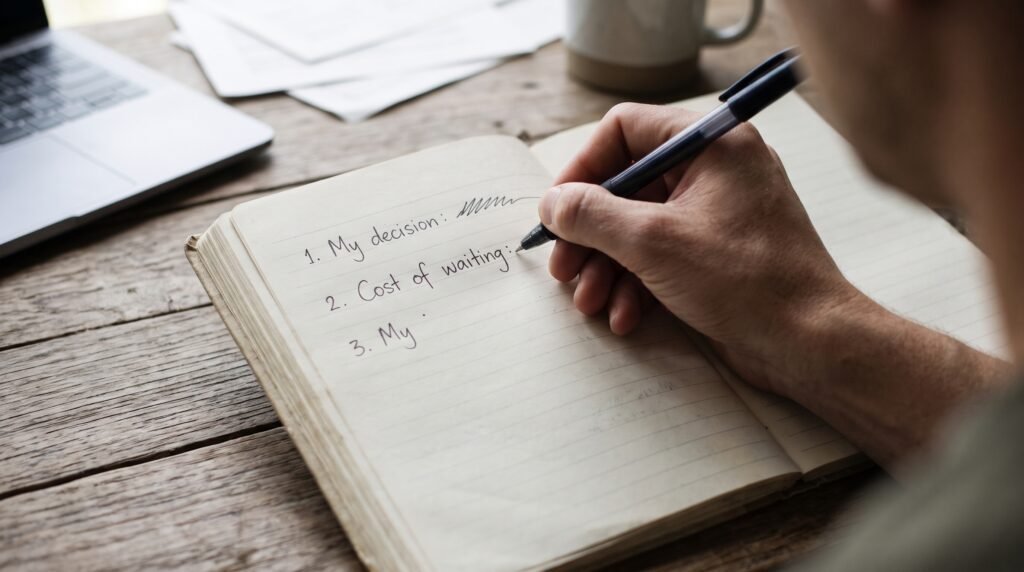
It is easy to nod along to a story from 2 Kings and go right back to your inbox without changing a thing. If you want to break the cycle of chronic hesitation, grab a piece of paper or open a blank note on your phone and work through three quick questions right now:
- Name the decision. Write down the one specific choice, conversation, or change you have been circling for more than a month. Keep it to one sentence. No vague goals—name the actual thing you are avoiding.
- Calculate the cost of another month. Be brutally honest about what happens if nothing changes over the next thirty days. How will your energy, your finances, your integrity, or your relationships look if you stay right where you are?
- Pick a 24-hour move. You do not need to solve the entire problem tomorrow. What is one concrete, irreversible step you can take in the next 24 hours that forces the situation forward? Send the email. Book the meeting. Cancel the subscription. Publish the page.
Moving Before the Fog Clears
Notice how the story in 2 Kings ends. The four men didn’t just save themselves; their willingness to walk into the dark ended up feeding an entire starving city. Had they stayed at the gate waiting for safer conditions, they would have died within sight of abundance.
God rarely hands out a complete map before asking us to move. Most of the time, clarity is something you find on the road, not something you negotiate before you leave the house. Stepping forward won’t guarantee that every camp you walk into will be empty, or that every risk will pay off the way you drafted it in your head. Sometimes moving means facing the exact hard thing you were trying to dodge.
Even then, you are alive, awake, and moving in the light instead of slowly fading out in the margins.
So look at the decision sitting in front of you today—the one you already wrote down, or the one that popped into your head the moment you started reading. You know what staying put is costing you.
Why stay here and die? Take the first step before the sun goes down.