

There’s a quiet kind of motivation that doesn’t shout for attention.
It doesn’t rely on praise, applause, bonuses, or validation.
It doesn’t collapse when no one’s watching.
It comes from within.
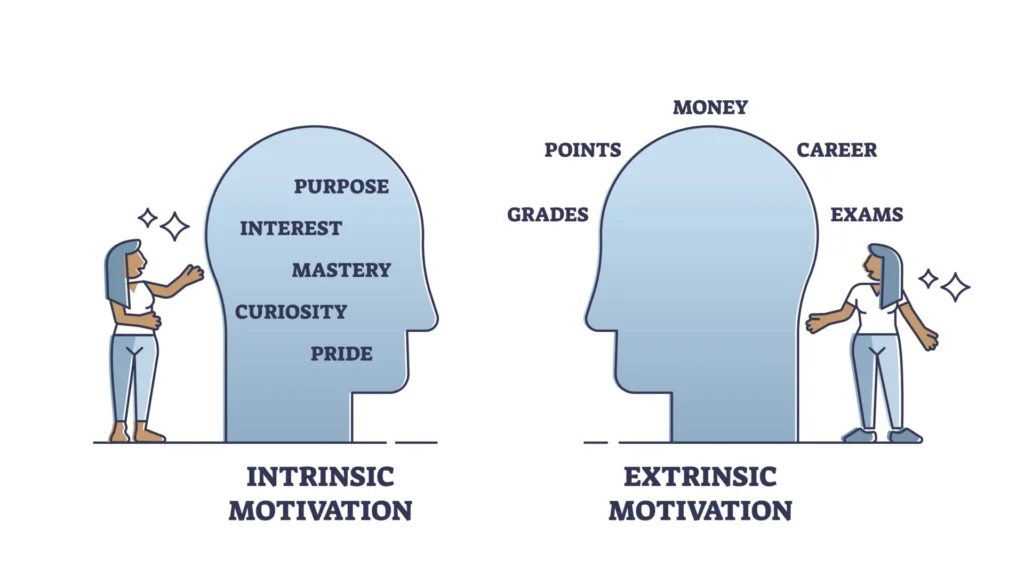
Intrinsic motivation is the internal drive to act because the action itself matters to you. Not because of a reward at the end. Not because someone told you to. Not because you’ll look good doing it.
And here’s the truth most people miss:
this form of motivation is slower to ignite—but far harder to extinguish.
In a world obsessed with hacks, incentives, and quick wins, intrinsic motivation is often overlooked. Yet it’s the very force behind long-term success, personal mastery, and sustained fulfilment.
Let’s break this down properly.
What Intrinsic Motivation Really Is (and What It Isn’t)
Intrinsic motivation is doing something because it aligns with who you are.
You work because the work feels meaningful.
You train because movement feels right.
You learn because curiosity pulls you forward.
No scoreboard required.
This doesn’t mean you never enjoy external rewards. It means those rewards are secondary, not the fuel source.
Contrast this with extrinsic motivation:
- Money
- Status
- Likes
- Approval
- Fear of punishment
- Pressure to keep up
Extrinsic motivation can be powerful—but it’s conditional. When the reward disappears, so does the drive.
Intrinsic motivation, on the other hand, is self-renewing.
It doesn’t ask, “What do I get?”
It asks, “Who am I becoming?”
Why External Motivation Fails Over Time
External rewards work brilliantly… at first.
They spark action.
They get things moving.
They help you start.
But here’s the problem: they don’t age well.
When motivation depends on outcomes you don’t fully control—praise, money, recognition—you hand your energy away. Your drive becomes vulnerable to circumstances, people, and fluctuations outside your control.
Over time, three things happen:
- The reward loses its emotional charge
What once excited you becomes normal. You need more to feel the same push. - Pressure replaces purpose
You keep going, but not because you want to—because you have to. - Burnout creeps in quietly
When effort is constantly exchanged for external validation, the internal well runs dry.
This is why so many people start strong and fade out.
Not because they’re weak—but because their motivation was borrowed, not owned.
The Quiet Power of Intrinsic Motivation
Intrinsic motivation doesn’t shout.
It doesn’t rush.
It doesn’t need an audience.
But it does something extraordinary: it keeps you going when enthusiasm fades.
Here’s what makes it different:
1. It’s Identity-Based, Not Outcome-Based
When motivation is intrinsic, action becomes an expression of identity.
You don’t write to get likes—you write because you are a writer.
You don’t train to impress—you train because you value strength and discipline.
You don’t build to prove anything—you build because building feels honest.
When action is tied to identity, quitting feels like a misalignment—not a failure.
2. It Survives Plateaus
External motivation thrives on progress.
Intrinsic motivation survives stagnation.
When results slow down (and they always do), internal motivation keeps you moving. Not with excitement—but with quiet commitment.
This is where most long-term success is forged.
3. It Creates Internal Standards
Instead of asking, “Is this good enough for others?”
You ask, “Is this true to my values?”
That shift changes everything.
You stop chasing validation and start refining your own standards. Growth becomes personal. Mastery becomes the goal.

Success isn’t just about getting results.
It’s about sustaining the behaviours that create them.
Intrinsic motivation excels here for three key reasons:
It’s Self-Sustaining
External motivation needs constant input—rewards, praise, incentives.
Intrinsic motivation regenerates itself through meaning, autonomy, and personal growth.
You don’t need to be pushed.
You pull yourself forward.
It Encourages Deep Engagement
When you’re internally motivated, you don’t do the minimum.
You explore.
You refine.
You go deeper.
This depth compounds over time, leading to skill, confidence, and resilience that shortcuts can’t replicate.
It Reduces Dependency
You become less reactive to circumstances.
Bad day? You still show up.
No recognition? You still care.
Slow progress? You still commit.
That emotional independence is a competitive advantage in every area of life.
How Intrinsic Motivation Actually Develops
Here’s the part that matters most.
Intrinsic motivation isn’t something you “find.”
It’s something you build.
And it builds through alignment.
1. Autonomy: Feeling in Control
You’re more motivated when you feel ownership over your choices.
Ask yourself:
- Where am I acting out of obligation rather than intention?
- What would this look like if it were my choice?
Even small adjustments restore autonomy—and motivation follows.
2. Mastery: Getting Better at Something That Matters
Progress fuels intrinsic motivation—but not superficial progress.
It’s the satisfaction of improvement:
- Understanding something more deeply
- Becoming more capable
- Refining your craft
Choose goals that allow you to grow, not just perform.
3. Meaning: Connecting Action to Values
The strongest intrinsic motivation comes from values, not goals.
Goals expire.
Values endure.
When what you’re doing connects to who you want to be, effort stops feeling like resistance—and starts feeling like expression.
A Subtle Warning: Don’t Romanticise Motivation
One important truth:
Intrinsic motivation doesn’t always feel good.
Sometimes it’s calm.
Sometimes it’s quiet.
Sometimes it’s just a steady sense of “this matters.”
If you’re waiting to feel motivated, you’ll miss it.
Intrinsic motivation often shows up as:
- Consistency over excitement
- Commitment without drama
- Progress without applause
That’s not weakness.
That’s maturity.
Practical Ways to Shift From External to Internal Motivation
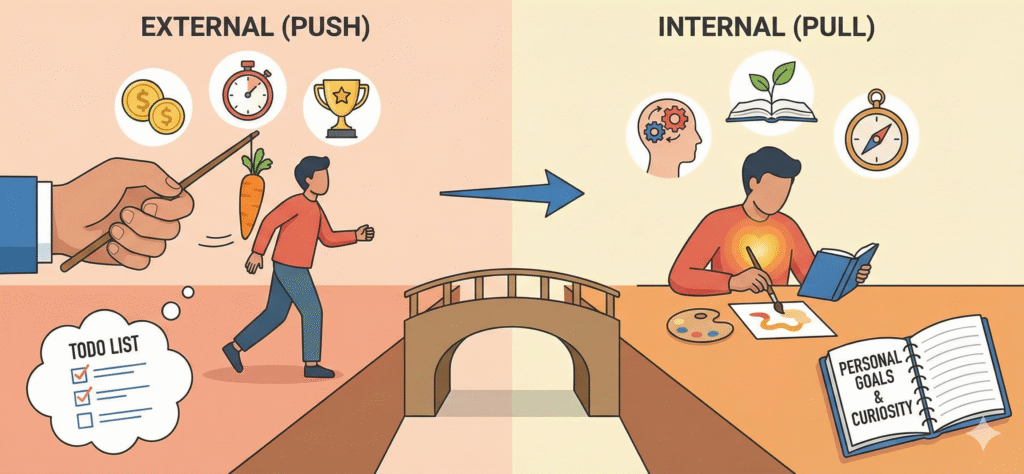
This isn’t about rejecting rewards—it’s about rebalancing the source.
Try this:
- Redefine success
Measure success by alignment and effort, not just outcomes. - Ask better questions
Replace “What will I get?” with “What will this develop in me?” - Detach from constant feedback
Less checking. Less comparing. More doing. - Choose fewer goals—but make them personal
If a goal doesn’t resonate internally, it won’t last.
The Long Game Always Favors the Internally Driven
External motivation is loud and fast.
Intrinsic motivation is quiet and enduring.
One gets you started.
The other keeps you going.
If you’re building a life, a body of work, or a version of yourself that lasts, the source of your motivation matters more than the intensity of it.
When your drive comes from within, success stops being something you chase—and starts becoming something you grow into.
And that kind of progress doesn’t fade when the noise dies down.
It deepens.