

We’ve all done it.
Sunday evening, fresh motivation, solid plan. This week is going to be different. Earlier starts, better focus, no more getting pulled off track.
By Wednesday it’s fallen apart. And somehow that feels like a personal failure.
It isn’t. The problem was never your willpower. It’s that willpower was never the right tool for this job.
Willpower Is a Battery — And It Runs Out
Willpower isn’t a character trait. It’s a finite resource.
It starts each day with a limited charge. Every decision you make, every distraction you resist, every uncomfortable task you push through — all of it draws from the same reserve. By mid-afternoon, that reserve is often nearly empty. Not because you’re weak. Because that’s how human beings actually work.
This is why you can feel sharp and disciplined on Monday morning and like a completely different person by Thursday afternoon. Nothing changed about who you are. The battery just ran low.
And it’s not just big decisions that drain it. Small ones do too. What to work on next. Whether to check your phone. Whether that email needs a reply now or later. These micro-decisions stack up quietly throughout the day — and by the time you need real focus, the tank is already half empty.
Relying on willpower alone to manage your time is like planning a long drive and just hoping the fuel takes care of itself.
The People Who Seem Disciplined Have a Different Secret
Ever notice how some people just seem to have it together? Consistent, focused, always following through — and never appearing to white-knuckle their way through the day?
They’re not running on superior willpower.
They’ve built systems and environments where the right behaviour is also the easiest behaviour. They’ve reduced the decisions that don’t need to be made in the moment. They’ve structured their days so that focus is the default — not something they have to fight for every single morning.
The difference isn’t discipline. It’s design. And if that idea resonates, the How to Win the Time Management War – Tactical Playbook breaks it down into a clear, practical framework you can start applying straight away.
The people who seem the most disciplined aren’t fighting themselves more. They’ve engineered their environment so there’s less to fight against.
Your Environment Is Doing More Than You Think
Your surroundings shape your behaviour constantly — often more than your intentions do.
A phone on your desk pulls at your attention even when you’re not using it. An open inbox tab is a standing invitation to switch context. A cluttered workspace creates low-level noise your brain is always half-processing. Even having too many browser tabs open can fragment your thinking before you’ve written a single word.
Willpower tries to fight all of that in real time, all day long. Good design removes it before the battle starts.
Put the phone in another room during focused work. Close the tabs you don’t need. Tidy the space before you start. If you work from home, consider having a specific spot that’s only ever used for deep work — somewhere your brain learns to associate with focus rather than browsing or admin.
These aren’t dramatic changes. They’re small environmental shifts that quietly reduce the load on your willpower so it’s available when you genuinely need it.
Motivation Shows Up After You Start — Not Before
One of the most common willpower traps is waiting to feel ready.
Waiting for motivation to arrive. Waiting for the right mood or the right moment or the right level of energy. That moment has a habit of never quite showing up on cue — especially for the tasks that matter most.
What actually works is slightly counterintuitive: start before you feel ready. Not the whole task — just the first two minutes of it. Open the document. Write one line. Make the first small move.
Action creates momentum. And momentum generates its own motivation. The hardest part of almost any task is simply beginning — once you’re in it, continuing becomes significantly easier. Most people never discover this because they keep waiting for the motivation to arrive first.
It doesn’t work that way. Begin anyway. The feeling follows.
Systems Beat Intentions Every Time
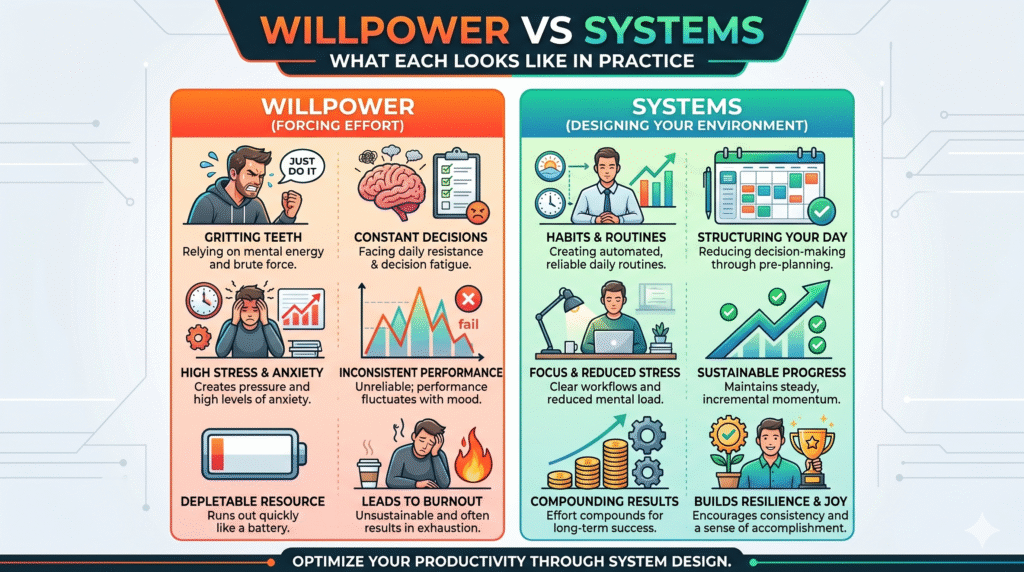
An intention says: I’m going to do my most important work first thing tomorrow.
A system says: My phone is in the kitchen, my laptop opens straight to the document, and tomorrow’s task is already written on a card next to my coffee.
See the difference? The system removes the need for willpower entirely. The decision is already made. The environment is already set. There’s nothing left to negotiate with yourself about in the morning.
Intentions are easy to form and easy to break. Systems are harder to ignore — especially when you’ve designed them well. This is the shift that actually sticks, and it’s the foundation that the How to Win the Time Management War – Tactical Playbook is built around. Not more discipline. Smarter structure. A practical framework that works with how you actually function, not against it.
Build Keystone Habits That Carry You
One more thing that makes a real difference: anchor habits.
A keystone habit is a small, consistent action that naturally pulls other good behaviours along with it. A ten-minute planning session at the end of each day. A five-minute desk clear before you start work each morning. A consistent shutdown routine that signals to your brain that the working day is done.
These habits don’t require much willpower once they’re established — they become automatic. And because they create structure around the parts of your day that are otherwise most vulnerable to drift, they quietly hold everything else in place.
Start with one. Keep it small enough that skipping it feels worse than doing it.
What to Do Instead of Trying Harder
Start small. Pick your single most important task for tomorrow and decide now — not in the morning — exactly when you’ll do it, where you’ll be, and what needs to be in place.
Then remove one distraction from your environment today. Just one.
That’s a system. Small, deliberate, repeatable. And infinitely more reliable than hoping motivation shows up on schedule.
Willpower is useful as a backup. It was never meant to be the whole plan. The people who manage their time well aren’t trying harder than you — they’ve just stopped leaving it to chance. If you’re ready to do the same, the How to Win the Time Management War Tactical Playbook is the place to start.